A standard walker is the better choice for most people who just need steady balance support, while a rollator wins when you need to sit down and rest. A walker is lighter and cheaper, but you must lift it with every step. A rollator rolls on wheels and carries a seat, so it suits longer trips and shaky stamina. If your hands or arms are weak, ask a physical therapist which frame you can actually lift.
Walkers and rollators side by side

Photo: www.surgo.com on Google
Both are mobility aids that give you something to hold while you walk, but they work in opposite ways. A walker stays put while you step, then you lift it forward. A rollator rolls with you and often gives you a seat. The table below compares the main types you’ll see in a store or online.
| Method | How long | Effort | Cost | Best for |
|---|---|---|---|---|
| Standard walker (no wheels) | Ready to use | High — lift each step | Low | Short indoor trips, firm floors |
| Two-wheel walker | Ready to use | Medium | Low to medium | Mixed indoor and outdoor use |
| Four-wheel rollator | Ready to use | Low | Medium to high | Longer trips, need to sit and rest |
| Heavy-duty bariatric rollator | Ready to use | Low | High | Higher weight capacity, wider seat |
“Ready to use” means no build time beyond attaching wheels or a bag, which takes a few minutes. What changes is daily effort, not setup. A standard walker asks more of your arms and shoulders. A rollator asks less of your body but more of your attention, because it can roll away on a slope.
Cost labels here are relative, not exact. Prices move with brand, brakes and seat size, so check the maker’s own site or your supplier for a current figure. Medicare and some insurance plans cover part of the cost when a doctor writes a prescription — the rules are on the Medicare mobility equipment page, and it’s worth reading before you buy.
How a standard walker works
A standard walker is a light metal frame with four rubber-tipped legs and no wheels. You place it, step to it, then lift and place it again. That lift is the whole method — and the whole problem for some people.
- Stand with your feet slightly apart, both hands on the grips.
- Move the walker one short step ahead — about 12 inches, no more.
- Step forward into it, leading with your weaker leg first.
- Bring your stronger leg level, then lift the walker ahead again.
- Repeat, keeping the frame flat on the floor between steps.
The 12-inch distance is a starting point for an average-height adult. If you’re taller, or your stride is longer, move it a little further; if you feel unsteady, shorten it until you feel stable.
The lift is what separates a standard walker from every wheeled frame. Nothing rolls away from you, so the frame takes your full weight the moment you lean on it. That’s why it’s the steadiest option on a firm, level floor — and the worst one on a thick rug or a loose mat, where a leg can catch instead of sliding.
A standard walker is great for firm, level floors and short trips around the house. It gives the most support of any frame because it can’t roll. Its weakness is that lift. If your grip is weak or you tire fast, that repeated lift gets unsafe — and a walker that tips mid-step is how people fall. Talk to a physical therapist before choosing this type if your arms or hands are weak.
A folding frame like the ST3004W medical walker is a typical example of a standard walker used at home and in care facilities.

How a rollator works
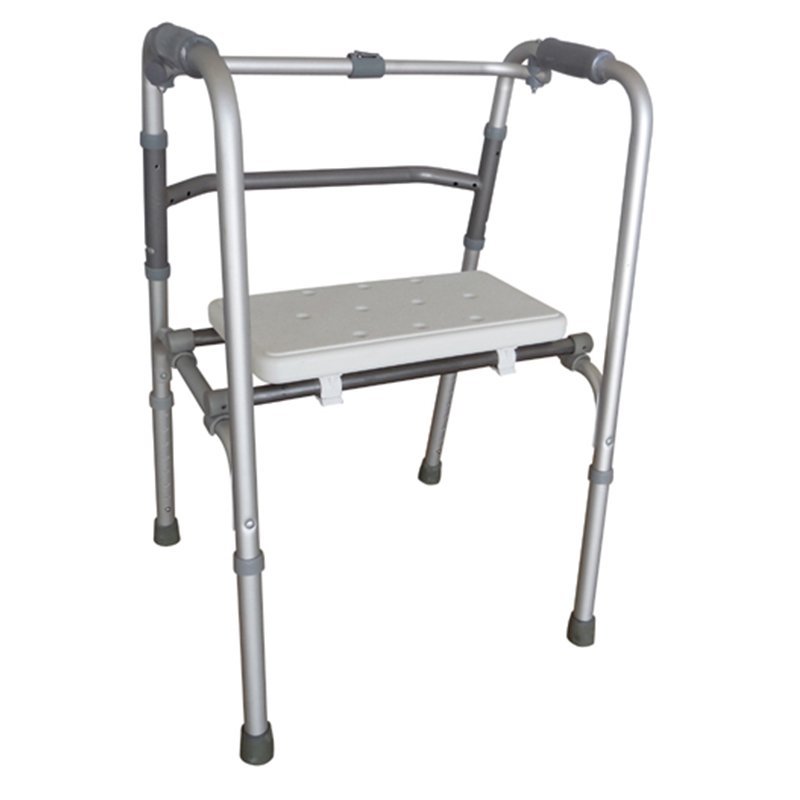
Photo: www.rentakneewalker.com on Google
A rollator has four wheels, hand brakes and usually a padded seat with a storage bag underneath. You push it like a shopping cart, and the brakes hold it still when you stop. It’s the frame most people picture when they hear the word “walker,” though it isn’t one.
- Squeeze both brake handles and lock them before you sit or stand.
- Push the rollator ahead of you as you walk, keeping your body close to it.
- Squeeze the brakes to slow down on slopes or turns — never coast.
- Sit only when the brakes are locked and the frame is on level ground.
- Check the wheels and brake cables every few weeks for wear.
Seat height matters more than most buyers expect. A seat that’s too low makes standing up hard, which defeats the purpose. Look for an adjustable seat and set it so your feet rest flat on the floor when you sit.
A rollator shines on longer trips, in stores, and anywhere you might need to rest. The trade-off is weight and bulk — most are heavier than a plain walker and harder to lift into a car. Its real weakness is momentum. On a ramp or a slick floor, a rollator can roll faster than you expect, so brakes aren’t optional.
A fourth type, the transport chair, looks similar but is pushed by someone else. It’s rarely worth buying unless a caregiver does the pushing, so it stays out of this comparison.
Which one fits your situation?
The right frame depends on your strength, your space and how far you go. There’s no single best pick — the answer changes with the day and the destination. Here’s how to decide for three common cases.
When you’re in a hurry. A two-wheel walker is the quickest to grab and use. It rolls forward on its front wheels and needs only a small tilt to move, so you’re not lifting the whole frame. It’s lighter than a rollator and faster to get out the door.
When it’s your first mobility aid. Start with a standard walker or a two-wheel model. It’s cheaper, simpler, and gives the most stability while you build confidence. Adding wheels and brakes before you’re ready can feel like too much to manage at once.
When you want the best result, whatever it takes. A four-wheel rollator with a seat and hand brakes wins. You get rest stops, storage and smoother rolling on uneven ground. The trade-off is the same one from the start: more features mean more weight, more cost and more to check.
One case flips the answer: narrow hallways and tight bathroom doors. A four-wheel rollator is often too wide to pass, and you end up folding it to get through. Measure your tightest doorway before you buy. If the rollator’s width is close to that number, a two-wheel walker fits where the rollator won’t.
If you walk less than a block and mostly indoors, the two-wheel model covers it. If you’re out for an hour or more, or you need to sit down partway, the rollator earns its weight. Buy for the trips you actually take this month, not the ones you picture next summer.
Notice the pattern. More wheels mean less effort but more to manage. Fewer wheels mean more support but more lifting. Pick the side of that line that matches your body today, not the one you hope to have next year.
What matters no matter which you pick
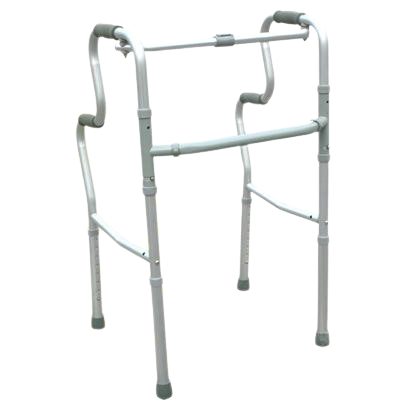
Photo: skywardmedical.com on Google
The frame is only half the answer. Fit, brakes and a few habits decide whether it actually keeps you safe, and they apply to every type on this list.
Get the height right first. Stand straight with your arms relaxed, and the grips should sit at the crease of your wrist. Too low and you’ll stoop; too high and you’ll hunch your shoulders. Most frames adjust with a push-button or a screw, so set it before your first real walk.
Check the weight limit. Every walker and rollator has a maximum user weight printed on a label or in the manual. If you’re near that number, look at a bariatric model instead — the standard frame isn’t built for it. The maker’s own specifications page lists the exact figure for each model.
Test the brakes and tips partway through each trip. Squeeze the brakes to confirm they grip, and look at the rubber tips or wheels for cracks or flattening. Worn tips are a common cause of slips on smooth floors.
Rubber tips wear faster than most people expect, and a tip that looks fine indoors can skid on wet pavement. Replace them at the first sign of a flat spot, and keep a spare set at home. If you use the walker daily outdoors, check the tips weekly rather than monthly.
The seat and backrest on a rollator are for resting, not for carrying. Bags hung on the handles pull the frame forward and make it tip when you stand up. Use the basket underneath if there’s one, and keep the load light.
At the end, fold it, lock it, and store it somewhere dry. And if balance, pain or weakness is getting worse, that’s a medical question, not a shopping one — see your doctor or a physical therapist, who can also fit the device to your body.
For lighter support, crutches and walking canes may be enough. You can also see our full range of medical walkers.
Frequently asked questions
What’s the difference between a walker and a rollator?
A walker has no wheels, or only two, and you lift it forward with each step. A rollator has four wheels, hand brakes and usually a seat. The walker gives more support but needs more arm strength. The rollator rolls with you and lets you rest, but it’s heavier and can move on its own on a slope.
Can I use a rollator instead of a walker?
Yes, if you have enough grip and balance to control the brakes. A rollator suits people who can walk but tire easily. If your arms are weak or your balance is very poor, a standard walker is safer. Ask a physical therapist to watch you walk with each one before you decide.
How long can I use a walker or rollator each day?
There’s no set daily limit. Most people use one for short trips of 10 to 30 minutes at a time, resting when tired. The real limit is your own stamina and your doctor’s advice, not the device. Stop and sit if you feel dizzy, and never push through pain in your hips, knees or back.
Is it safe to sit on a rollator seat?
Yes, if you lock both brakes first and the ground is level. Never sit on a slope or with the brakes off — the rollator can roll out from under you. Check the seat’s weight limit in the manual, and make sure the frame is fully open and clicked into place before you lower yourself onto it.
What happens if I use the wrong type?
You may fall, strain your shoulders, or simply stop using it. A frame that’s too heavy to lift, or too hard to steer, often ends up in a closet. That lost independence is the real cost. A physical therapist can match the device to your strength, height and home so you actually keep using it.
How much do walkers and rollators cost?
Prices vary widely by type, brand and features, so there’s no single figure. Standard walkers cost the least, four-wheel rollators with seats cost more, and heavy-duty models cost the most. Check your supplier or the maker’s site for current prices, and ask your doctor about insurance coverage — Medicare covers part of the cost with a prescription.
Coverage rules are listed on the official Medicare walkers page.
Conclusion
Before you buy anything, ask a physical therapist or doctor to watch you walk and try both frames in person. They’ll spot what you can’t, and you’ll avoid wasting money on gear that doesn’t fit your body or your daily routine.
If walking becomes too tiring even with a rollator, a wheelchair may be the next step. Our guide on how to choose the right wheelchair size explains how to measure.
Sourcing walkers and walking aids for your market?
MOSTA MEDICAL is a CE and ISO certified factory in Guangdong, China, supplying distributors, hospitals and brand owners in 15+ countries. We offer factory-direct pricing and OEM/ODM branding.
Browse walkers · Email info@mostamedical.com · WhatsApp us for a quote